
Get Help Collaborate
Jump to:Industry initiatives | Non-profit initiatives | Blueprint
Navigate the noise
This is where we help you navigate all of the Scope 3 ‘noise’ to help you reach the best collaborative efforts. Below are some of the initiatives that we actively collaborate with.
Industry initiatives
Chemicals
Together for Sustainability
What
Together for Sustainability (TfS) is a member-driven initiative, raising CSR standards throughout the chemical industry. Our members are chemical companies committed to making sustainability improvements within their own – and their suppliers’ – operations. Together we are building the global standard for environmental, social and governance performance of chemical supply chains.
Why
Through TfS Assessments and Audits, our members measure the Management, Environmental, Health & Safety, Labour & Human Rights, and Governance performance of their suppliers. Areas requiring improvement are addressed through Corrective Action Plans.
How
Pharmaceutical
The Pharmaceutical Supply Chain Initiative (PSCI)

What
The Pharmaceutical Supply Chain Initiative (PSCI) is a group of pharmaceutical and healthcare companies who share a vision of excellence in safety, environmental, and social outcomes in the communities where we buy.
Why
We believe that by sharing knowledge and expertise, PSCI members can work as one voice to drive complex, global change more effectively than any one organisation alone.
We have joined forces to instil and drive responsible value chain management and better business conditions across the industry.
How
Chemicals
Global Impact Coalition

What
The Global Impact Coalition unites industry majors across the chemical value chain to co-develop breakthrough solutions, accelerating them to commercial scale. Their CEO-led platform doesn’t just talk about sustainability – they make it happen through tangible projects with measurable impact.
Why
The Scope 3 Peer Group’s more advanced Peers (our “Innovation for Impact” Working Group) identified the need for more collaborative effort around the decarbonization of the chemicals value chain. We’re delighted to be supporting the GIC and working together to support Peers to accelerate these efforts.
How
Automotive
Suppliers Partnership for the Environment

What
Since 2002, the Suppliers Partnership for the Environment (SP) has provided a leadership forum for global vehicle manufacturers and their large and small suppliers to work together toward a shared vision of an automotive industry with positive environmental impact.
SP’s members work together toward through member-driven working groups to facilitate best practice sharing and support increased collaboration related to industry environmental sustainability needs and priorities.
Why
Suppliers Partnership provides a forum for global vehicle manufacturers and their large and small suppliers to work together toward a shared vision of an automotive industry with positive environmental impact.
How
Non-profit initiatives
World Business Council for Sustainable Development (WBCSD)

What
The World Business Council for Sustainable Development (WBCSD) brings together transformational organizations to form a global community that shifts the systems they work within towards a better future. Its members push the boundaries of what businesses can achieve by taking action to limit the climate crisis, restore nature and tackle inequality. The mission is for all people to thrive in a sustainable way for our planet by 2050.
WBCSD’s collaborative initiatives include:
Why
WBCSD’s sustainable development and business education programs give members the tools they need to make best practices part of their every day and ultimately improve both performance and sustainability competence.
We have a strategic partnership to support all WBCSD work on scope 3, including PACT.
CDDA is a partner on the Innovation for Impact program and we are on their Advisory Board.
We aim to provide all our scope 3 case-studies through the Climate Drive.
How
Science Based Targets initiative (SBTi)

What
The Science Based Targets initiative (SBTi) is a corporate climate action organization that enables companies and financial institutions worldwide to play their part in combating the climate crisis.
We develop standards, tools and guidance which allow companies to set greenhouse gas (GHG) emissions reductions targets in line with what is needed to keep global heating below catastrophic levels and reach net-zero by 2050 at latest.
Why
The SBTi defines and promotes best practice in emissions reductions and net-zero targets in line with climate science. It develops standards, tools and guidance to enable companies and financial institutions to set science-based targets in line with the latest climate science. And through its wholly-owned subsidiary, SBTi Services, assesses and validates companies’ and financial institutions’ targets
We support the SBTi’s efforts to standardise and clarify scope 3.
How
We Mean Business

What
We are a global nonprofit Coalition working with the world’s most influential businesses to take action on climate change.
Together, we catalyze business and policy action to halve global emissions by 2030 in line with a 1.5°C pathway.
Why
We collaborate with a core group of seven business-focused climate nonprofit organizations to accelerate the transition to a just and climate resilient net zero economy. These founding partners help to deliver key initiatives and activities that are central to the success of the overall Coalition's bold objectives. Beyond this core group, we also collaborate with a wider network of organizations that help to realize our shared vision at speed and scale.
We support We Mean Business’ SME Climate Hub.
How
Chancery Lane Project

What
The Chancery Lane Project helps organisations reduce emissions using the power of legal documents and processes. We are a charity registered in the United Kingdom, working in over 110 countries.
Why
Join the largest global network of lawyers and business leaders using climate contracting to deliver fast and fair decarbonisation.
The Chancery Lane Project run our Climate Contracts Working Group.
How
Sustainable Procurement Pledge
What
The Sustainable Procurement Pledge is a global, inclusive community of procurement professionals. It is building a movement built on exchange, learning and collaboration, guided by the principles of The SPP Pledge.
Why
SPP is part of a global movement of changemakers. It does not duplicate but build upon the wealth of expertise and experience of our community and the initiatives of others to fill the gaps that are holding change back. SPP builds impact-driven connections to ecosystem partners, promoting procurement as a lever to accelerate change.
The SPP host the Carbon Pricing Principles for Procurement.
How
RMI (formerly Rocky Mountain Institute)

What
RMI is an independent, nonpartisan, non-profit that transforms global energy systems through market-driven solutions to secure a clean, prosperous, zero-carbon future for all.
Why
They work in the world’s most critical geographies and engage businesses, policymakers, communities, and non-governmental organizations to identify and scale energy system interventions that will cut greenhouse gas emissions at least 50 percent by 2030.
RMI support our Innovation for Impact program
How
Blueprint activity to decarbonize value chains together
The Blueprint, developed in partnership with Accenture, outlines a strategic framework for industries to collectively decarbonize and emphasizing the necessity of joint investment and collaborative efforts.
Beginning with the Life Sciences industry and working together, we can not only accelerate the transition to a low-carbon future but also set a precedent for sustainable practices that can be replicated globally.
7 topic areas | 25+ capabilities | 20 standards and regulations
30+ collaborating working groups
Proliferation of activity
Huge quantity of work and hundreds of isolated efforts looking towards similar goals
The why?
A common point of view
To drive it, we need a common point of view on what’s already out there, and where to focus
Hard to prioritize
Hard to focus finite resources across this effort and determine time & effort
A shared direction
Our industry blueprint aims to create a new industry effort
Value in collective action
There is value in collective investment and action across value chains
Leading the way for industry collaboration
We can extend our approach with other industries, and help them set up similar efforts
The solution
Today
Multiple, similar efforts across the same industry value chain

Tomorrow
A shared direction to align industry efforts and investment

Draft Blueprint for Life Sciences
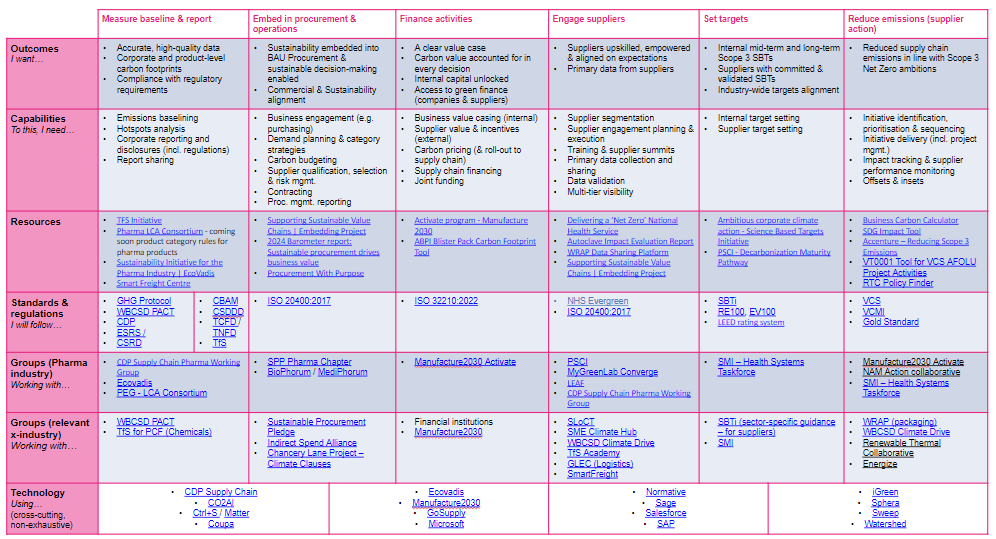
How to read the Blueprint
I want [outcome]
To achieve this, I need [capabilities]
I will follow [standards]
Working with [groups]
And using [technology] to drive efficiencies
Measure baseline & report
Establishing emission baselines, analysing emission hotspots, and transparently sharing corporate reports and disclosures to drive informed actions and accountability
The Blueprint focuses on 7 topics
Engage suppliers
Collaborating with and training suppliers, collecting and validating primary data, and achieving N-tier visibility to effectively lower carbon emissions throughout the value chain
Embed in procurement & operations
Embedding sustainability in procurement aligning commercial activities with sustainability goals through supplier qualification, risk management, and procurement contracts
Set targets
Setting internal short, mid-term, and long-term Scope 3 SBTs, aligning with industry-wide targets, and ensuring supplier commitment to collectively make progress towards decarbonisation objectives
Finance activities
Developing internal business value casing for decarbonisation, incentivising suppliers, implementing carbon pricing schemes, providing supply chain financing, and collaborating on joint funding initiatives
Supplier action & emission reduction
Identifying, prioritizing, and sequencing initiatives, managing project delivery, tracking impacts, monitoring supplier performance, and utilizing offsets and insets
Educate
Providing suppliers with the knowledge, tools, and best practices necessary to identify, manage, and minimise their carbon footprint, and setting clear expectations for their actions